
An iCresset Insight | Leadership Hiring | June 2026

India’s C-suite is under transformation. Boards are not just filling vacant chair, they are making strategic bets on who will carry their organisations through AI disruption, regulatory complexity, and an increasingly competitive global economy. The cost of getting this wrong has never been higher. And the window to get it right has never been narrower.
At iCresset, we have spent years at the intersection of leadership hiring and business strategy. What we are witnessing today is a structural shift, not a cyclical blip.
The Numbers Tell the Story
India Inc stepped up its pace of senior hiring significantly in FY2025. According to the foundit Insights Tracker (December 2025), senior management roles recorded the strongest hiring growth at 39% year-on-year outpacing every other function, including IT (+30%) and HR (+33%). This is not coincidental. It reflects how sharply organisations are prioritising the quality of leadership as a core competitive advantage.
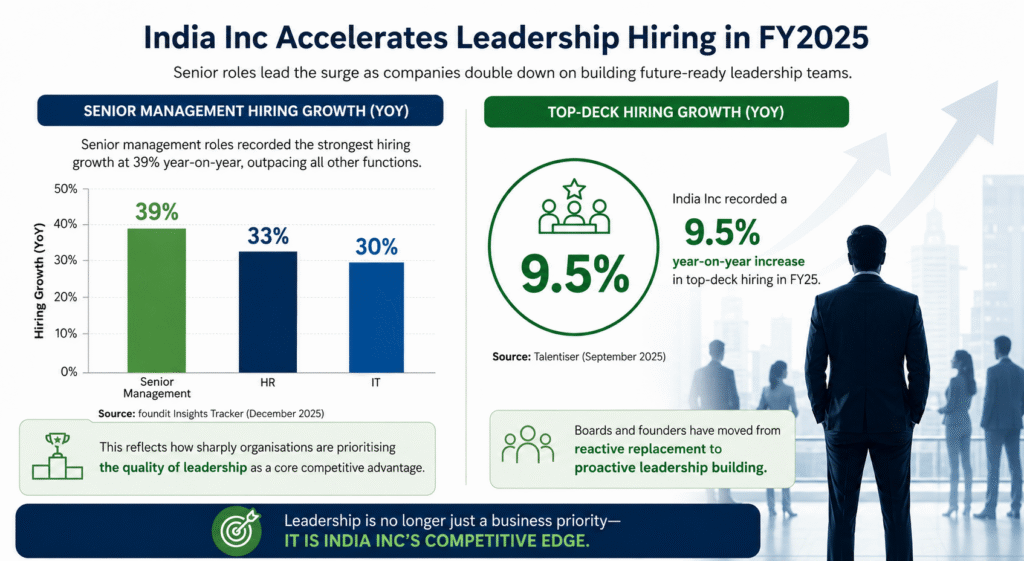
At the same time, India Inc recorded a 9.5% year-on-year increase in top-deck hiring in FY25 (Talentiser, September 2025). Boards and founders have moved from reactive replacement to proactive leadership building.
Yet the supply side is not keeping pace. Demand for leaders with domain-specific expertise, especially in AI governance, cybersecurity, sustainability, and digital finance is outpacing available talent. This talent crunch is making the sourcing, assessment, and retention of the right leader more consequential with every passing quarter.
What Has Changed: The New Leadership Bar
For most of the past two decades, boards looked for CXOs with strong pedigree credentials, long tenures, blue-chip employers, steady career progression. That framework has cracked.
Today’s CXO must simultaneously run the business and future-proof it. Boards across India’s industrial, BFSI, pharma, and consumer sectors are asking a more demanding set of questions:
- Can this leader navigate AI transformation? This is no longer a tech-sector question. Every organisation in India including manufacturing, agri-business, life sciences, financial services is now, in some form, a technology company. The preference is increasingly for CXOs who have led AI adoption with measurable outcomes, not merely approved budgets for it (Propella Consulting, January 2026).
- Does this leader have a global mindset? As India’s economy becomes more globally integrated, driven by GCC expansion, export growth, and cross-border supply chains, companies are seeking leaders who can manage multicultural teams, navigate international regulatory frameworks, and deliver at scale.
- Can this leader build resilience? The post-pandemic decade has proven that crisis management and business continuity are not soft skills. Leaders who can construct strong teams and prepare for the unpredictable are commanding a premium.
The GCC Effect: A New Demand Driver for Senior Talent
One of the most significant demand accelerators for leadership hiring in India right now is the GCC (Global Capability Centre) boom. As of June 2025, 50% of GCCs in India intended to expand their workforce beyond 2024 levels (Economic Times, June 2025). Mid-sized GCCs are now outpacing larger peers in recruitment growth and they need leaders, not just operators.
GCCs are creating a new class of leadership roles that blend Indian delivery expertise with global strategic accountability. Filling these roles demands a search partner who understands both worlds.
The Real Cost of a Wrong Leadership Hire
One reason leadership hiring demands a disciplined, structured process is the asymmetric cost of failure.
A poorly chosen CXO does not merely underperform. They consume strategic momentum, erode team morale, signal confusion to the board and investors, and trigger a costly replacement cycle. Research consistently shows that a bad senior hire costs organisations between 3x to 5x the annual salary of the role, and at the C-suite level, where packages include ESOPs, LTIs, and relocation costs, that number compounds rapidly.
Beyond the financial cost, there is the damage that is harder to quantify: the initiatives that stalled, the talent that left, the competitive advantage that was lost.
As one leadership analyst put it precisely: “Recruit poorly and you don’t just lose time; you lose strategic momentum.” (Talentiser, 2025)
The New Hiring Architecture: How Leading Organisations Are Responding
The most sophisticated organisations are rethinking their entire approach to leadership acquisition. Here is what best practice looks like:
1. From Iterative Search to Precision Search: Generic job postings and broad outreach yield generic candidates. The organisations winning the war for talent are engaging search partners who deploy precision methodologies, deep domain expertise, pre-mapped talent intelligence, and competitor landscape analysis before a search even begins.
2. Science Alongside Instinct: Psychometric assessments, leadership simulations, and 360-degree evaluation frameworks are now standard in rigorous leadership hiring. These tools exist not to replace human judgment but to make it sharper, surfacing behavioural patterns, leadership derailers, and cultural alignment signals that interviews alone cannot reveal.
3. Behaviour and Culture Over Credentials: Companies are increasingly using psychometric assessments and competency-based interviews to ensure alignment between a leader’s behaviour, values, and the organisation’s culture, not just their resume credentials (CXO Hiring in India 2025 report).
4. Broadening the Search Geography: Leadership strength today lies where the work happens, not just where the headquarters sit. Tier-2 cities like Ahmedabad (+21% YoY hiring growth), Coimbatore (+24% YoY), Jaipur, and Chandigarh are emerging as legitimate leadership hubs. Operating in these cities can reduce leadership costs by nearly 30% while accessing high-calibre talent with local market insight (ET HR Trends Report 2025; Corporate Stalwarts, 2025).
5. Proactive Talent Mapping over Reactive Hiring: The most forward-thinking organisations do not begin a leadership search when a seat is vacant. They continuously map the talent landscape in their sector, track competitor leadership movements, and build warm pipelines, so that when a critical need arises, they are not starting from zero.
What This Means for Your Organisation
If you are a CHRO, CEO, or board member in India today, the question is not whether leadership hiring has become more complex. It has. The question is whether your current approach to finding, assessing, and securing leadership talent matches the complexity of what is being demanded.
The organisations that will win over the next decade are not those with the deepest pockets, compensation packages have been broadly equalised. They are the organisations with the sharpest intelligence about where the right leaders are, the most rigorous process for evaluating them, and the most credible brand as a place where leaders can do consequential work.
At iCresset, we call this Millennial Leadership. Sharpened. And it is as relevant today as it has ever been.
iCresset Talent Solutions is a specialist executive search and talent consulting firm, operating across leadership hiring, talent mapping, psychometric assessment, and salary benchmarking. With 170+ clients and 2,000+ mid-to-senior leadership placements, we bring domain precision to India’s most complex talent challenges.
For leadership hiring mandates or talent consulting enquiries, write to us at enquiry@icresset.com or call +91 9121150496.