
An iCresset Insight | Agri & Food Sector | June 2026
Ask any HR leader at a leading agrochemical company, a food processing conglomerate, or a fast-scaling agritech startup, and they will tell you the same thing: finding the right senior leader for this sector is harder than it looks from the outside. And it is getting harder every year.
The talent war in India’s agri and food sector is real. But it is a fundamentally different kind of war from the one being fought in IT, BFSI, or consumer goods. Different terrain, different rules and a very different definition of what “the right leader” actually means.
At iCresset, we have spent years executing senior mandates for some of India’s most respected agribusiness and food companies from billion-dollar agri-input MNCs to PE-backed food processing ventures. This is our read on what makes this sector’s talent challenge unique, and what organisations must do differently to win.
The Sector Is Too Big to Ignore And Too Specialised to Generalise
India’s food processing sector, already one of the world’s largest, was valued at approximately US$ 354.5 billion in 2024 and is expected to reach US$ 758.4 billion by 2028, growing at a CAGR of 8.38% (IBEF, 2025). From April 2000 to June 2025, the sector attracted US$ 13.49 billion in FDI. The government’s Production Linked Incentive (PLI) scheme for food processing, with an outlay of Rs. 10,900 crore, has further accelerated investments and new capacity creation.
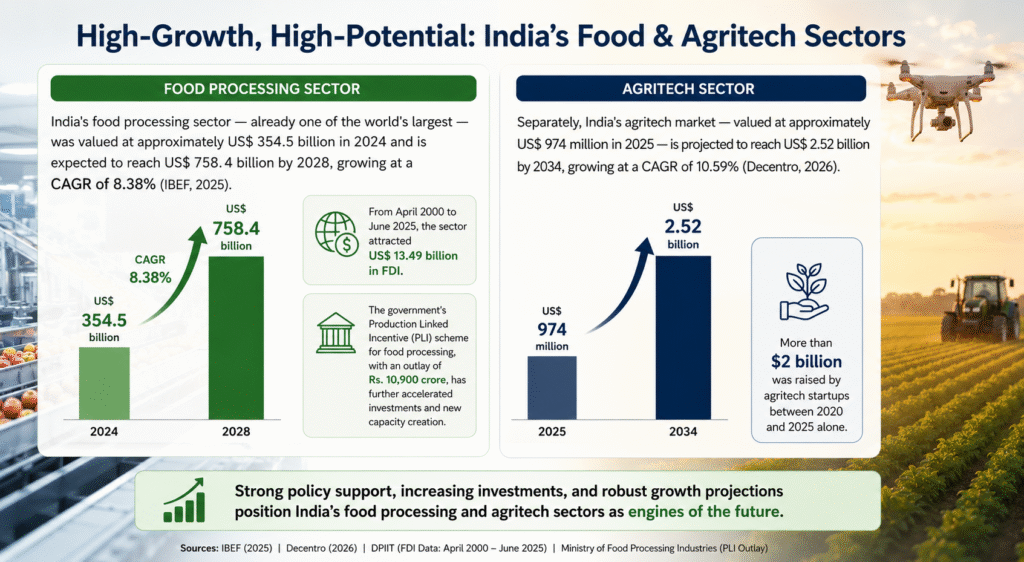
Separately, India’s agritech market, valued at approximately US$ 974 million in 2025 is projected to reach US$ 2.52 billion by 2034, growing at a CAGR of 10.59% (Decentro, 2026). More than $2 billion was raised by agritech startups between 2020 and 2025 alone.
Add to this the government’s ambitious Viksit Bharat@2047 vision, which projects India’s food processing sector growing to US$ 1.1 trillion by FY35, and the picture becomes clear: this is a sector on a long-term growth trajectory, with an enormous and sustained appetite for leadership talent at every level.
Yet this growth has not been matched by a corresponding expansion of senior leadership supply. In fact, the talent gap is widening and the reasons are structural, not cyclical.
Why This Sector’s Leadership Talent War Is Different
1. The Rare Dual Requirement: Domain Depth + Business Sophistication
This is the central challenge of leadership hiring in agribusiness and food. Unlike sectors where management excellence can be imported from a generic business school pipeline, the agri and food sector demands something rarer: leaders who combine deep domain expertise with modern business and commercial acumen. For instance, a Head of Crop Protection Business, for instance, cannot lead effectively without understanding agronomy, regulatory science, and farmer behaviour at the ground level. But they also need to build P&Ls, manage distributed sales organisations, navigate pricing pressures, and execute digital strategies.
2. The Shrinking Leadership Pipeline
Globally, up to 50% of the agricultural workforce is approaching retirement age, and the next generation of leaders has not yet accumulated the seasoning that senior roles demand. In the Indian context, the pattern is compounded by a persistent issue: talented agri graduates systematically migrate to better-paying industries like FMCG, pharma, or consulting, leaving the sector with a thinning mid-tier pipeline from which future leaders are meant to emerge.
The quality of agricultural education in India, while improving, has historically placed limited emphasis on sales, marketing, business strategy, and commercial leadership. This means that even the qualified domain experts who remain in the sector often need significant development on the business side before they are ready for senior roles.
The consequence is a dangerously thin bench of “ready-now” senior leaders and intense competition among companies for the same small pool.
3. A Sector in the Middle of a Technology Transition
The agri and food sector in India is undergoing a technology transformation that has no precedent in its history. Precision agriculture, AI-powered agronomic advisory, supply chain digitisation, drone-based field operations, IoT-enabled cold chains, and satellite imagery platforms are all reshaping how agribusinesses operate and compete.
The result is a new class of leadership roles that did not exist five years ago and a new set of competencies required of leaders across existing roles. A Business Head at a large agri-input company now needs to understand digital distribution, farmer data platforms, and direct-to-farmer commerce. A Supply Chain Head at a food company needs to manage not just cold chain logistics but predictive inventory systems.
Yet the pipeline of leaders who combine this technology fluency with sector knowledge is extremely thin. The agritech sector led by funded startups like DeHaat (US$ 270 million+ in funding), Ninjacart (US$ 407 million+ in funding), and a rapidly maturing cohort of precision agriculture and supply chain platforms is competing aggressively for the same digitally fluent talent pool, with startup equity and growth-stage excitement as differentiators.
4. Culture and Context Are Non-Negotiable
Agribusiness and food organisations, particularly Indian ones carry distinct cultures shaped by legacy, purpose, and the realities of operating in rural and semi-urban India. A leader who thrives in an urban FMCG environment may struggle deeply in a role that requires travelling to tier-3 districts, navigating farmer communities, managing channel relationships built on trust over decades, or operating in a slower-moving regulatory environment.
Culture mismatch in this sector is not merely uncomfortable, it is costly. Field-facing leadership roles are particularly vulnerable, because a leader who cannot earn the respect of farmer networks, dealer ecosystems, and ground teams loses effectiveness almost immediately.
A candidate might look exceptional on paper. But if they cannot align with the organisation’s operational culture and the realities of the ground, the hire fails. This is a lesson many agri companies have learned the hard way and it reinforces why assessment of behavioural and cultural fit is as important as technical evaluation in this sector.
5. The Retention Problem Is Structural
Even when the right leader is found and hired, retaining them is its own challenge. PE-backed agritech startups, global food MNCs entering India, and newly funded agri platforms are offering aggressive compensation packages that legacy agri-input and food processing companies find difficult to match. The global competition has intensified this: Indian agribusiness leaders with the right profile are increasingly on the radar of international firms, and remote work has eliminated many of the geographic barriers that once kept them in place.
What the Best Organisations Are Doing Differently
- Building Intelligence Before the Search: The agri and food sector’s talent pool is small enough, and concentrated enough, that reactive search beginning only when a position is vacant, is an expensive mistake. The best companies in this sector maintain live talent intelligence: who leads which business at which competitor, which leaders are at an inflection point in their careers, and what the compensation landscape looks like for each role. This is what we call Talent Mapping and in this sector, it is not a luxury. It is table stakes for any organisation that expects to hire competitively within an acceptable timeframe.
- Widening the Search Geography: The next generation of agri and food leadership talent in India is not concentrated to just tier-1 cities, It is in dozens of tier-2 cities where the industry’s operational heart actually beats. Searches confined to metro talent markets will miss a disproportionate share of the sector’s best leaders. The ET HR Trends Report 2025 noted that hiring in smaller cities jumped 21% year on year, overtaking metro hiring and this trend is as relevant to senior agribusiness leadership as it is to any other function.
- Thinking Across the Entire Value Chain: The agri and food sector in India is extraordinarily diverse spanning seed technology, agri-inputs, crop protection, food processing, dairy, cold chain logistics, food retail, food-tech, and agritech platforms. Each sub-sector has its own talent dynamics, competitive landscape, and leadership requirements. A search partner who understands only the agri-input world cannot effectively serve a food processing client. The best hiring decisions in this sector are made by organisations who work with partners possessing genuine, granular domain knowledge across the value chain, not just in one segment of it.
- Assessing for the Dual Requirement: Given the rarity of leaders who combine domain depth with business sophistication, the assessment process must be designed to probe both dimensions rigorously. Psychometric tools, leadership simulations, and structured behavioural interviews are essential, not just to validate credentials but to surface how a candidate thinks about ambiguity, how they engage with field-level realities, and whether they can bridge the worlds of technical expertise and commercial leadership. Job Fit Assessment, evaluating a candidate against a precise definition of the role, not a generic job description is especially valuable in this sector, where the gap between what looks right and what actually works can be significant.
The Agritech Disruption: A New Dimension to the Talent War
One force reshaping leadership hiring in India’s agri sector deserves special mention: the rise of agritech. India’s agritech sector now has over 1,300 active startups (Farmonaut, 2025), and the Digital Agriculture Mission with a budget of Rs. 2,817 crore (FY24–FY26) has given policy momentum to this shift.
These startups and the established companies now racing to build their own digital capabilities are creating entirely new leadership roles: Chief Digital Officers for seed companies, Head of Farmer Engagement Platforms for fertiliser businesses, VP of Precision Agriculture for large farm management organisations. These roles require profiles that the sector has no historical precedent for, making them among the most challenging searches in the space.
For established agri and food companies, the competition is sharpest at exactly the interface of domain knowledge and digital fluency, a combination the sector can least afford to get wrong, and can least afford to lose.
What This Means for Your Organisation
If you lead an agri-input business, a food processing company, a dairy organisation, or an agritech platform in India, here is the honest assessment: the leadership talent you need is out there, but it is scarce, it is being competed for intensely, and it will not stay available for long.
The organisations winning this talent war are not necessarily the largest or the most well-funded. They are the ones with the sharpest intelligence about where the talent is, the most disciplined process for evaluating fit across both the domain and the business dimensions, and the most credible employer proposition for leaders who have choices.
iCresset Talent Solutions has a strong track record of senior leadership mandates across India’s agri, food, and allied sectors — from billion-dollar agri input MNCs to PE-backed agritech ventures. Our domain advisory team brings 20+ man years of experience in agribusiness, enabling precision search rather than iterative outreach.
For leadership mandates or talent research in agri, food, or allied sectors: enquiry@icresset.com | +91 9121150496