
An iCresset Insight | Agritech | Talent Strategy | June 2026
There is a particular kind of confidence that comes with early-stage success. You have raised your Series B. Revenue is growing. The founding team is firing on all cylinders, investors are engaged, and hiring is happening fast. Everything feels like it is working.
And then a key leader leaves.
It might be your Head of Operations, who built your entire rural fulfilment network. Or your VP of Agronomy, who was the face of your farmer advisory programme. Or a co-founder who quietly held together the commercial and technology functions. Suddenly, what felt like a well-oiled machine reveals itself to be something more fragile: an organisation held together by a handful of exceptional individuals with no structured plan for what comes next.
This is the leadership pipeline problem in India’s agritech sector. It is common, it is costly, and in 2026, it is entirely avoidable.
The Scale of the Opportunity and the Pressure That Comes With It
India’s agritech sector is no longer a niche experiment. The market is projected to grow from US$ 9 billion in 2025 to US$ 28 billion by 2030, as the sector moves beyond farm-level pilots into infrastructure-led models spanning storage, financing, and market access. India’s agritech market was valued at approximately US$ 974 million in 2025 and is projected to reach US$ 2.52 billion by 2034, growing at a CAGR of 10.59%.
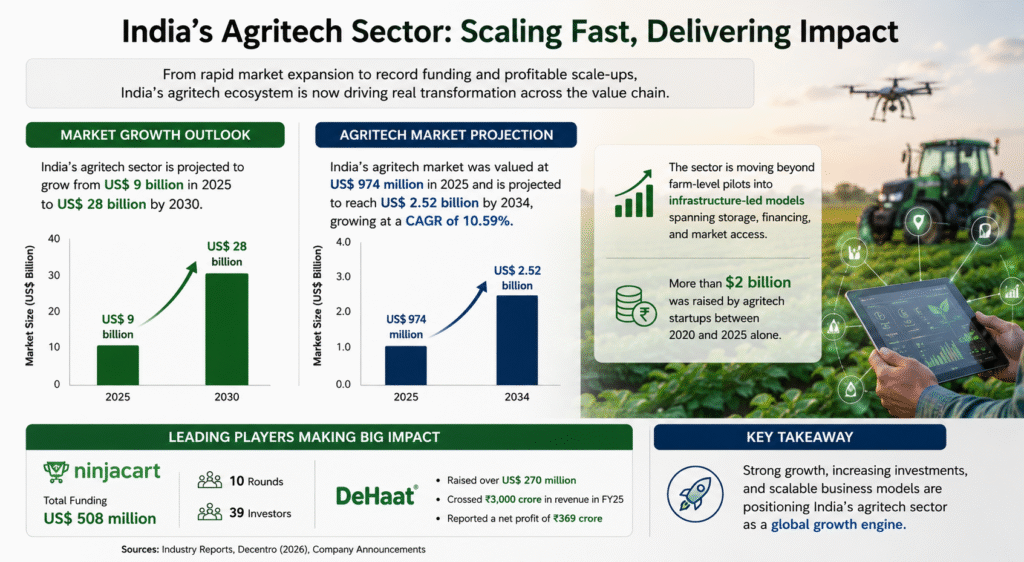
The most funded players have crossed meaningful thresholds: Ninjacart has raised a total of US$ 508 million across 10 rounds from 39 investors, while DeHaat, India’s most funded full-stack agritech platform has raised over US$ 270 million and crossed Rs. 3,000 crore in revenue in FY25, reporting a net profit of Rs. 369 crore.
At this scale, these are no longer startups in the conventional sense. They are operating businesses, managing thousands of employees, serving millions of farmers, running complex multi-state supply chains and financial services operations. And they need a leadership infrastructure to match.
Yet most have not built one.
The Founder Dependency Trap
India’s startup ecosystem is candid about this problem when pressed. Indian startups appointed 50 new CEOs in 2025, including 21 internal elevations and also saw 35 leaders exit their positions. The churn extended to co-founders, with multiple high-profile exits reshaping senior teams across sectors. In agritech specifically, where domain knowledge is hard-won and relationships with farming communities take years to build, a senior exit does not just leave an empty seat. It takes institutional memory, farmer trust, and operational knowledge with it.
The underlying pattern is consistent across agritech companies at growth stage: the founding team built the product, raised the capital, and won early market traction but did not build the second line of leadership that would allow the organisation to scale without founder dependency. When a senior leader exits, there is no one ready to step up from within. The organisation begins a reactive search that takes months, disrupts operations, and almost always ends in an external hire who needs six to twelve months to become effective.
According to a 2025 SHRM India report, nearly 67% of mid-to-large Indian enterprises admit they do not have a documented succession plan beyond the top two leadership levels. In the agritech sector, where companies grow from 50 to 500 people in 18 months and functions are often built around whoever was available rather than whoever was best, the number is almost certainly higher.
Why Agritech Startups Are Particularly Exposed
The leadership pipeline challenge hits agritech companies harder than most, for reasons specific to the sector.
- The Dual Expertise Problem Runs Deeper Here: Every agritech role of consequence requires a combination of technical or domain knowledge and management capability. A Head of Farmer Advisory cannot lead without genuine agronomic credibility, farmers and field teams will see through a generalist instantly. But they also need to manage distributed teams, design scalable programmes, and present business cases to leadership. Building a pipeline of leaders who credibly hold both sides of this equation takes years of deliberate development. Most startups have not started.
- The Talent Pool Is Structurally Thin: Unlike fintech or SaaS, where the leadership talent pool draws from a broad ecosystem of technology companies and financial services firms, agritech sits at the intersection of agriculture and technology, a combination that very few professionals have had the opportunity to develop. The agribusiness sector in India faces a talent crunch partly because talented graduates are shifting from agribusiness to other industries for higher-paying jobs, and because the quality of agri-education varies significantly, with limited emphasis on sales, marketing, and business leadership. This means that when an agritech startup loses a senior leader, their replacement is not readily available in the open market. The search takes longer, the options are fewer, and the compromises are greater.
- Investor Pressure Drives Short-Termism in Hiring: Growth-stage agritech companies are under constant pressure to show quarterly progress against metrics. This creates a natural incentive to hire fast to fill seats quickly and keep the growth story intact, rather than to hire well. Roles are filled reactively, onboarding is compressed, and the investment in developing internal talent gets perpetually deferred in favour of near-term execution.
- Attrition Is High and the Competition for Talent Is Fierce: For the first time in 2025, agritech emerged as one of the sectors leading India’s startup funding recovery and capital is back, but chasing real value, governance, and resilience, not just top-line growth. This has intensified competition for the small pool of experienced agritech leaders. Established players compete with new entrants. PE-backed ventures compete with VC-funded platforms. Legacy agribusiness companies recognising the threat from agritech, now compete for the same hybrid talent. The result is a seller’s market for experienced agritech leaders, and a dangerous vulnerability for any company whose senior team’s retention is not actively managed.
What “Thinking Like a Legacy Company” Actually Means
India’s large agri-input corporations like the Bayers, Syngenthas, ITCs, and UPLs, have known for generations that rural market leadership is built over time, not hired in overnight. They have invested in structured training academies, rotational programmes, internal talent identification systems, and leadership development tracks that span years. They are imperfect organisations in many ways, but they have leadership pipelines. Their senior leaders can name their successors. Their second-rung managers have a development plan.
Agritech startups have dismissed this as corporate bureaucracy. It is not. It is institutional resilience and the agritech sector needs to build its own version of it.
Here is what that looks like in practice:
- Define the critical roles, not just the current headcount. A leadership pipeline starts with identifying which roles, if vacant tomorrow, would most impair the organisation’s ability to operate or grow. For most agritech companies, these include the Head of Farmer Network, the Head of Supply Chain or Agri Operations, the Chief Technology Officer, and the commercial leadership. Knowing which roles matter most is the first step toward protecting them.
- Define the critical roles, not just the current headcount. A leadership pipeline starts with identifying which roles, if vacant tomorrow, would most impair the organisation’s ability to operate or grow. For most agritech companies, these include the Head of Farmer Network, the Head of Supply Chain or Agri Operations, the Chief Technology Officer, and the commercial leadership. Knowing which roles matter most is the first step toward protecting them.
- Build exposure, not just experience. The fastest way to develop a future leader in agritech is to give them cross-functional exposure early. The agronomist who works alongside the supply chain team for six months, or the technology lead who spends time in the field with farmer relationship managers, develops the dual perspective that the sector’s leadership roles demand. This does not happen by accident. It requires deliberate structuring.
- Treat retention as a pipeline strategy. Retaining star executives is just as difficult as hiring them in a competitive marketplace, with lucrative counter-offers and increasing burnout making CXO-level attrition a growing concern making robust retention frameworks, including leadership coaching, equity incentives, and meaningful work, essential. For agritech companies, meaningful work is rarely the problem. The absence of a clear leadership pathway often is. Senior professionals who cannot see where they are going within the organisation will eventually leave for one where they can.
- Map the external talent landscape proactively. Even the best internal pipeline will have gaps. Talent Mapping, maintaining a live view of which leaders exist in the agritech and adjacent agribusiness ecosystem, what their career trajectories look like, and when they might be open to a move allows companies to move quickly and confidently when an external hire is genuinely needed, rather than scrambling reactively.
The Investor Lens: Why This Is Now a Governance Question
There is a dimension to the leadership pipeline conversation that founders sometimes miss: investors are now watching it closely.
Succession planning is a priority for most organisations, but execution remains the biggest challenge and only four in ten respondents believe their CEO succession planning adequately positions the organisation for the future, according to Deloitte India’s Talent Readiness Study 2025-26.
For PE and late-stage VC investors in agritech, the leadership pipeline is a due diligence question, not just an HR question. A company with a deep, developed second line of leadership is a more defensible investment than one where everything depends on two or three individuals. When founders present their Series D or prepare for pre-IPO scrutiny, the question will come: who runs this business if you step back?
The companies that can answer that question confidently with names, development plans, and a talent architecture will command better terms, better valuations, and better investor relationships.
India’s agritech sector is at a defining moment. The companies that will lead it a decade from now are not necessarily the ones with the most capital or the most clever technology. They are the ones that build organisations with systems, pipelines, and leadership dept, that can survive and grow through the inevitable departures, transitions, and challenges that every organisation faces.
That is what legacy companies learned, usually the hard way. Agritech can learn it differently by choosing to build the pipeline before the vacancy arrives.
iCresset Talent Solutions specialises in senior leadership hiring and talent research for India’s agri and food sector — including agritech platforms, agri-input companies, food processing ventures, and allied sectors. Our talent mapping practice gives agritech leadership teams a live view of the external landscape, so decisions are always made from a position of intelligence rather than urgency.
To discuss a leadership mandate or talent strategy engagement: enquiry@icresset.com | +91 9121150496